
In certain situations, it is possible to give an opinion of what should be done on the basis of the patient’s medical records alone. This happens in one of the following two extreme cases:
- when the patient is neither very young nor very old, is completely free from disorders or symptoms, the diagnosis is certain, staging (i.e., the degree of extension of the disease) is certain, and there is no possibility that the cancer in question might be one of those special forms that can benefit from biological therapies, which have few toxic effects.
- when the patient is very old or in such a poor condition that he is confined to bed and cannot look after himself, and his vital organs, such as kidneys or liver, can no longer work properly. Naturally, in this second situation, too, the above-mentioned conditions must be met: the diagnosis is certain, staging is certain and there is no possibility that the cancer is one of those special forms.
It is almost impossible for someone who is not a doctor to be sure that all these conditions are met. So that, even if the above-mentioned extreme conditions are met, giving advice online can still lead to mistakes. Indeed, this type of advice does not take into account the psychological aspect of the individual patient: what he knows and does not know; what he wants to know; his priorities and values, etc.
Medical decisions (FIGURE 27) are taken on the basis of:
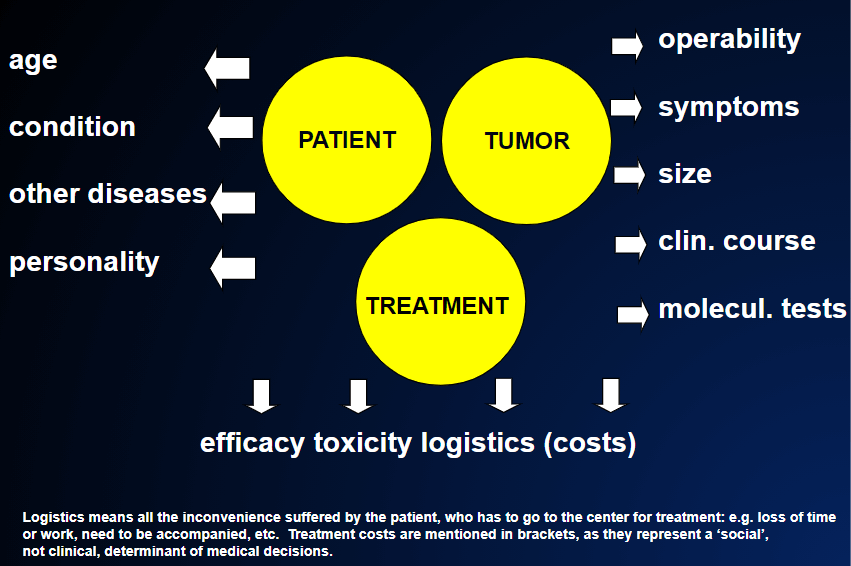
- how the patient feels, what she knows, wants to know and expects;
- how serious the doctor thinks the situation is;
- to what extent he thinks the patient can benefit from therapy;
- how much he thinks the patient may suffer because of the disease and the therapy.
All of this is practically impossible online.
What can be found online is the range of possible therapies indicated by the international guidelines. This does not mean that we can reach a decision on therapy, much less obtain an indication of the most appropriate therapy for that specific case.
There are specialized online services which provide further information on the situation and comments on the pros and cons of the possible decisions. A word of warning, however: the clinical analysis of the case must be carried out by a doctor in contact with the patient, otherwise the interpretation of the case and the advice received risks being based on incomplete or misleading information.